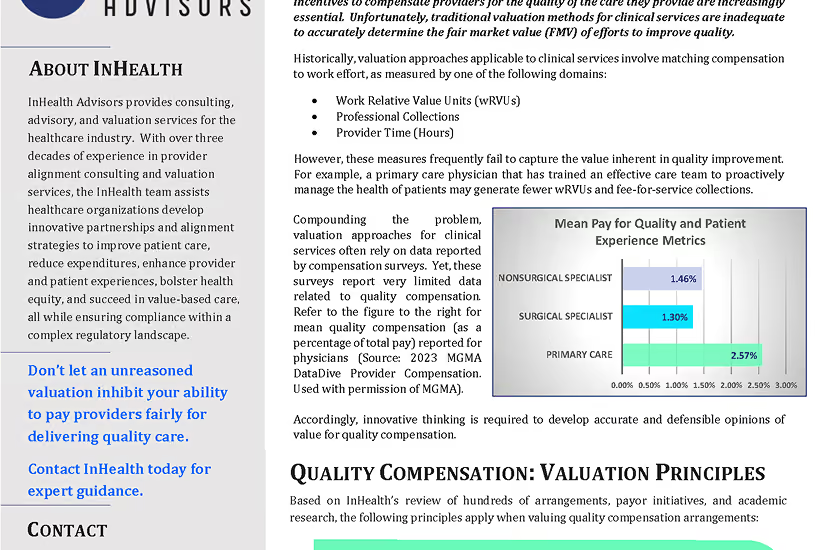
The changes contained within the 2021 Medicare Physician Fee Schedule (MPFS) created a myriad of complexities for integrated delivery systems (IDSs). While the 2022 version of the MPFS did not introduce ground-breaking revisions to relative value units or payment policies, it did include numerous changes in both payment and program requirements that will have a significant impact on IDSs continuing their transition toward value-based care (VBC). This article provides a brief overview of the major impacts to VBC that will be ushered in by the 2022 MPFS, as summarized in the following figure.
| Summary of Key 2022 MPFS Changes |
|---|
|
The 2022 final rule stipulated an MPFS conversion factor of $33.5983, which represented a 3.71 percent decrease from the 2021 conversion factor of $34.8931. On December 10, 2021, President Biden signed the Protecting Medicare and American Farmers from Sequester Cuts Act into law. This legislation limited the budget neutrality adjustment applied by CMS to 0.82 percent ($0.2861). Additionally, the law introduced a phased reduction in Medicare sequestration cuts for 2022 and a temporary suspension of the scheduled 4.0 percent “PAYGO” cuts. As a result, and without further legislative adjustments, the MPFS conversion factor is scheduled to decline throughout the year as follows.
| Period | Conversion Factor |
|---|---|
| January 2022 – March 2022 | $34.6062 |
| April 2022 – June 2022 | $34.2573 |
| July 2022 – December 2022 | $33.9083 |
The Centers for Medicare and Medicaid Services (CMS) finalized a number of changes to Quality Payment Program (QPP) policies in the 2022 MPFS. It stated a desire to utilize the QPP to “advance health equity and address social determinants of health.” The 2022 MPFS implemented certain statutory requirements to the Merit-based Incentive Payment System (MIPS). CMS also indicated that MIPS Value Pathways (MVPs) and the Alternative Payment Model (APM) Performance Pathway (APP) are expected to be “key program changes that support our efforts to move the needle forward on value.”
CMS made a host of updates to the traditional MIPS program for 2022, including the following:
Added clinical social workers and certified nurse midwives to the list of MIPS eligible clinicians.
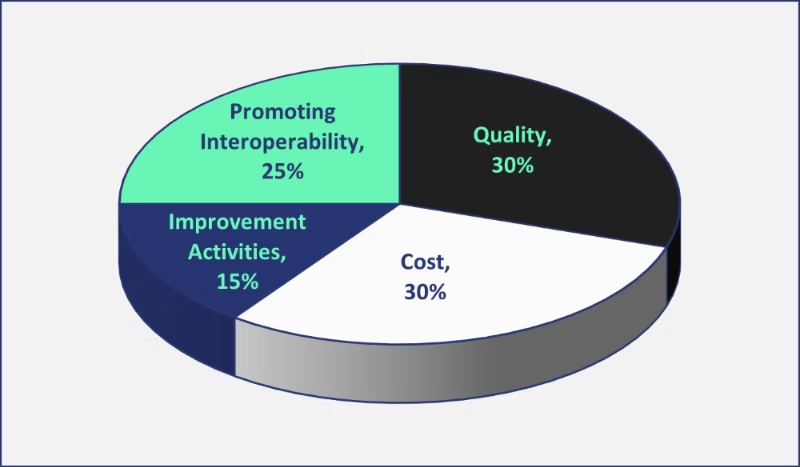
Established the performance threshold for the 2022 performance year/2024 payment year using the mean final score from the 2017 performance year/2019 MIPS payment year. Specifically, the performance threshold is set at 75 points, which represents an increase of 15 points from the 2021 performance year/2023 payment year threshold of 60 points. The additional performance threshold also increased by 4 points to 89 points, which represents the 25th percentile of final scores above 75 points from the 2017 performance year/2019 payment year. The 2022 performance year/2024 payment year is currently scheduled to be the last year MIPS will incorporate the additional performance threshold.
| Quality | Cost | Improvement Activities | Promoting Interoperability |
|---|---|---|---|
| Removed end-to-end electronic reporting and high priority/outcome bonus points | Added 5 episode-based cost measures (Melanoma Resection, Colon/Rectal Resection, Sepsis, Diabetes, Asthma/COPD) | Added 7 new improvement activities, 3 related to health equity | Automatic reweighting for clinical social workers and small practices |
| Extended CMS Web Interface as quality reporting option for groups/virtual groups/APM entities | Set minimum case requirements (Asthma/COPD 20, Colon/Rectal 20, Diabetes 20, Melanoma 10, Sepsis 20 episodes) | Modified 15 current improvement activities, 11 addressing health equity | Revised Public Health/Clinical Data Exchange reporting to support PHAs |
| Updated quality measure inventory to 200 total measures | Established new process for developing episode-based cost measures (CY2022 dev, 2024 adoption) | Removed 6 previously adopted improvement activities | Added exclusion for Electronic Case Reporting measure (2022 only) |
| Removed 3-point floor for scoring measures (some small-practice exceptions), beginning 2023 | — | — | Added requirement to attest to annual High-Priority SAFER Guides assessment; updated Information Blocking attestation |
Based on these changes, CMS opined: “We anticipate clinicians will start to see greater returns on their investment in the [MIPS] program. Additionally, changes from the rule will result in a more equitable distribution within our scoring system, with small practices no longer bearing the greatest share of the negative payment adjustments.”
In the 2022 MPFS Final Rule, CMS finalized 7 MVPs, along with policies to support implementation of these MVPs, beginning in the 2023 performance year. It indicated that MVPs are anticipated to “allow for a more cohesive participation experience by connecting activities and measures from the four MIPS performance categories that are relevant to a specialty, medical condition, or episode of care.” MVPs will include the same quality, cost, and improvement activities performance categories found in traditional MIPS, along with foundational measures for promoting interoperability and population health.
CMS defined the first 7 MVPs that will be available in the 2023 performance year.
| MVPs for the 2023 Performance Year |
|---|
| Advancing Rheumatology Patient Care |
| Coordinating Stroke Care to Promote Prevention and Cultivate Positive Outcomes |
| Advancing Care for Heart Disease |
| Optimizing Chronic Disease Management |
| Adopting Best Practices and Promoting Patient Safety within Emergency Medicine (finalized with modification) |
| Improving Care for Lower Extremity Joint Repair (finalized with modification) |
| Support of Positive Experiences with Anesthesia (finalized with modification) |
MVPs will allow eligible multispecialty groups to participate as a subgroup “to provide patients and clinicians with information that’s clinically meaningful at a more granular level.” It defined a subgroup as “a subset of a group [that] contains at least one MIPS eligible clinician and is identified by a combination of the group TIN, the subgroup identifier, and each eligible clinician’s NPI.” Subgroup reporting will be voluntary for the 2023, 2024, and 2025 performance years. Multispecialty groups must form subgroups in order to report MVPs beginning in 2026.
MVP scoring policies generally will align with those used in traditional MIPS across all performance categories. Performance category weights will be consistent with traditional MIPS performance category weights. Reweighting policies for the redistribution of category weights will also generally be consistent with those of the traditional MIPS program.
Reporting requirements for MVP participants include:
| Quality | Cost | Improvement Activities | Promoting Interoperability |
|---|---|---|---|
| Choice of 4 quality measures including one outcome measure | Specific cost measures for each MVP | Choice of 2 medium-weighted or 1 high-weighted activity | Same PI measures as traditional MIPS (unless eligible for reweighting) |
| Choice of one population health measure | — | — | Subgroups submit PI data at group level (not subgroup level) |
CMS expects to provide comparative performance for “like clinicians who report on the same MVP.” Public reporting is planned to be delayed until 2024 to provide participants an opportunity to familiarize themselves with MVP scoring and reporting.
There were no major changes to the APP announced in the 2022 MPFS Final Rule. The most significant change announced was that APP participants will be able to report as a subgroup beginning with the 2023 performance year. The definition of a subgroup and eligibility to participate as a subgroup are the same as the requirements for MVP reporting subgroup reporting only to clinicians reporting through MVPs or the APP.
CMS delayed the requirement for accountable care organizations (ACOs) to report electronic clinical quality measures (eCQMs) and MIPS clinical quality measures (CQMs), which require the submission of quality data for all payors, not just Medicare. Specifically, ACOs will not be required to report the three eCQMs/MIPS CQMs for the APP until 2025.
CMS also delayed by one-year the planned increase in the Medicare Shared Savings Program ACO quality performance standard that ACOs must meet to share in savings and avoid maximum losses (if applicable), as well as an additional incentive to encourage ACOs to report all-payer measures. ACOs will now have until 2025 to transition to the increased Shared Savings Program quality performance standard.
CMS continued its overhaul of evaluation and management visit requirements by revising its policies regarding the billing of split (or shared) evaluation and management (E&M) visits, critical care services, and teaching physician services.
CMS modified its policies regarding split (or shared) E&M visits to “better reflect the current practice of medicine, the evolving role of non-physician practitioners (NPPs) as members of the medical team, and to clarify conditions of payment that must be met to bill Medicare for these services.”
%20Evaluation%20and%20Management%20Visits.avif)
The 2022 MPFS final rule provided the following new guidance for billing split/shared E&M visits to the Medicare program:
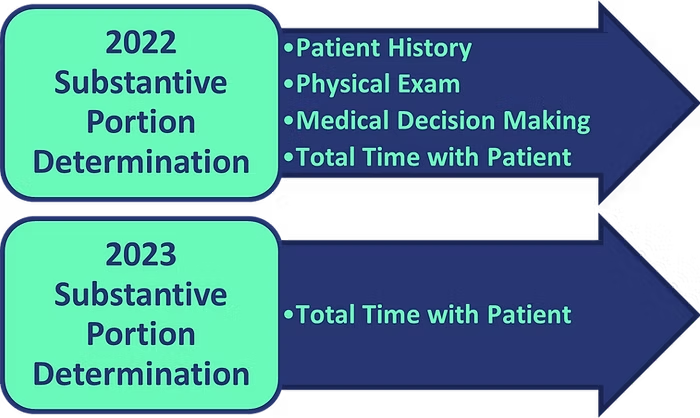
As is typically the case, if the substantive portion of the visit is performed by an NPP, current MPFS reimbursement policies include a reduction in the payment amount for the services (e.g., 15 percent reduction for services performed by nurse practitioners and physician assistants). This change could result in a significant impact to the revenue generated by facility-based providers.
CMS clarified the following policies related to billing for critical care services:

In the 2022 MPFS, CMS specified that, if time is used to select an office-based E&M visit level, only the time spent by the teaching physician in qualifying activities, including the time that the teaching physician was present with the resident performing those activities, can be included for purposes of selecting the appropriate visit level. If teaching services are provided utilizing the primary care exception, only medical decision making may be used to select the E&M visit level, since residents may require additional time to perform E&M services.

Prior to 2022, Medicare could not make payments directly to physician assistants (PAs). Beginning January 1, 2022, PAs may bill Medicare directly for their professional services, reassign payment for their professional services, and incorporate with other PAs and bill Medicare for PA services. Services billed directly by PAs will be subject to the standard 15 percent reduction from the physician payment amount.
CMS has temporarily added numerous procedures to the Medicare list of telehealth services during the COVID-19 pandemic. The 2022 MPFS stipulates that those procedures will remain on this list through 2023 to provide CMS more time to evaluate leaving such services on the Medicare telehealth services list permanently. The 2022 MPFS also extended inclusion of certain cardiac rehabilitation services on the Medicare telehealth services list through the end of 2023 and permanently added a virtual check-in procedure to the list.
As authorized by the Consolidated Appropriations Act, 2021, the 2022 MPFS codified a permanent change to certain geographic restrictions for approved mental health telemedicine services and added the home of the beneficiary as a permitted originating site. CMS also clarified that its definition of “home” includes temporary lodging, such as hotels and homeless shelters, or other locations near the patient’s home. However, to utilize these relaxed geographic restrictions, CMS requires an in-person, non-telehealth service within six months prior to the initial telehealth service. CMS further stipulates that an in-person, non-telehealth visit must be provided to the patient at least every 12 months, but that “exceptions to the in-person visit requirement may be made based on beneficiary circumstances.”

CMS also amended its definition of “interactive telecommunications systems” for mental health telehealth services to include audio-only, interactive telecommunications system for services provided by practitioners with the capability to offer two-way, audio/video communications, when the patient does not have, or does not consent to use, two-way, audio/video technology.
In future editions of Insights InHealth™, we will examine the ramifications of each of these changes in more detail and review the strategies that progressive IDSs may utilize to navigate the 2022 MPFS in their journey toward VBC.

Lorem ipsum dolor sit amet, consectetur adipiscing elit. Suspendisse varius enim in eros elementum tristique. Duis cursus, mi quis viverra ornare, eros dolor interdum nulla, ut commodo diam libero vitae erat. Aenean faucibus nibh et justo cursus id rutrum lorem imperdiet. Nunc ut sem vitae risus tristique posuere.
Share this entry: