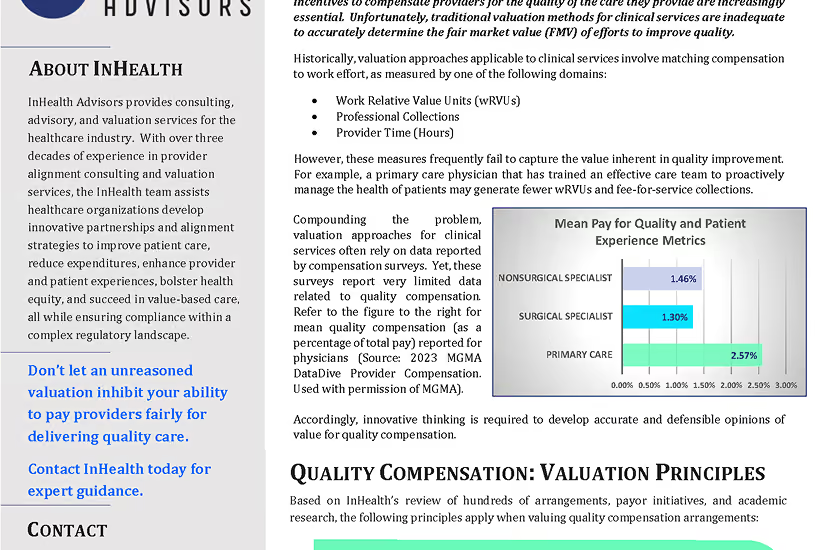
The growth of telemedicine has provided hospitals and health systems with a powerful tool in delivering value-based care (VBC). When deployed correctly, telemedicine can reduce costs, while increasing access to care (for a contemporary discussion of this topic, refer to this link) [1] while also maintaining or improving clinical quality (based on a recent study). [2] While initially used by hospitals to access key professional services in the absence of in-person and on-call providers, telemedicine increasingly offers efficient avenues into delivering higher quality care at reduced costs.
To maximize alignment with VBC initiatives, telemedicine service arrangements (TSAs) must be thorough in addressing the services, revenues, and costs involved. This edition of Insights InHealth outlines the top 5 missteps we have observed in TSAs and how both hospitals and telemedicine companies can avoid the misalignment with VBC associated with them.
Initially, telemedicine providers were limited in their ability to receive reimbursement from payors for their professional services. Over time, the Centers for Medicare and Medicaid Services (CMS) and private payors have increased the circumstances in which they allow reimbursement for telemedicine services. Additionally, the COVID-19 pandemic led to unprecedented flexibilities in the delivery of telemedicine, including significant latitude regarding allowable services (including non-face-to-face telephonic encounters) and relatively generous payment rates for such services. The degree to which the flexibilities will remain is left to be seen; for example, CMS is adopting a wait-and-see approach, while sunsetting some of the more generous flexibilities.
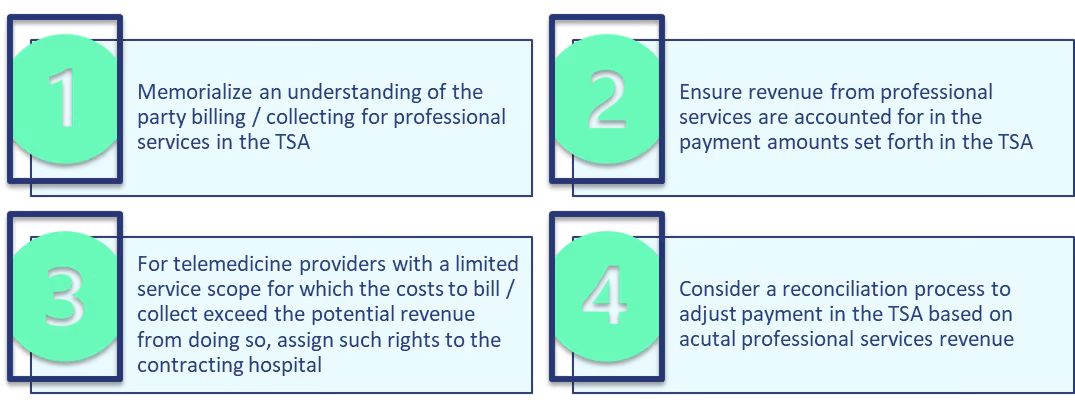
Given the uncertainty around the extent and amount of reimbursement for telemedicine services, it can be difficult for the parties to establish which services can be billed and what revenue to expect from the services. As a result, the parties may be tempted to remain silent on the topic in the TSA. However, this misstep can lead to the following trip-ups related to VBC:
Hospitals maintain a variety of service lines with varying hours of operations and response time needs. For example, stroke centers require the continuous availability of telestroke providers able to respond emergently, while outpatient psychiatry departments often operate during normal business hours and schedule services with ample notice beforehand. Accordingly, telemedicine providers can be engaged to provide professional services for time periods and with response times that match the needs of the contracting hospital.
Notwithstanding this variability, we have observed that TSAs frequently do not clearly define the desired period of availability and response time requirement. A common source of dissatisfaction between hospitals and telemedicine providers is the consistency of response, both in relation to the initial request for a clinical service and follow-up related to prior services (e.g., clarifications related to medical documentation). That said, longer periods of availability and shorter response times impose additional costs on telemedicine providers, which may lead to higher compensation amounts in the TSA.
At a minimum, we recommend that TSAs detail: (1) the hours per day and days per week the telemedicine provider will be available (we note it is common for weekends and holidays to require longer periods of telemedicine availability); and (2) the target or minimum average time for both an initial response and commencement of clinical services. Furthermore, we recommend that a regular quarterly meeting is held for hospital service line leadership and telemedicine practice management to discuss operations.
Part of the cost savings associated with telemedicine providers arises from their ability to leverage professional staff across numerous facilities. This article from Wheel Health[3] details the economics of improved cost efficiency achieved by telemedicine staffing models. This is in contrast to in-person staffing and on-call staffing (where concurrent coverage is limited by the ability of the provider to physically present to the covered hospitals within the required response time). Non-exclusive availability does not impact hospital operations if a telemedicine provider has sufficient staff to meet the response time requirements. However, certain service lines do require the exclusive time of a telemedicine provider. We have frequently observed that outpatient service lines with scheduled patients and inpatient service lines with designated rounding requirements require telemedicine providers to designate fixed blocks of exclusive provider time.
Therefore, it is important for the TSA to specify if exclusive provider time is required, and if so, when that exclusivity is needed. Exclusivity will result in higher costs to hospitals since the telemedicine provider will be dedicated to a single hospital during that time block. Conversely, when a telemedicine provider is not required to be exclusive to a hospital, the payment rates should decrease to reflect that ability for their staff to cover multiple facilities. If this documentation is overlooked in the TSA, the following trip-ups may occur:
As the number and scope of practice expands for advanced practice professionals (APPs), this segment of the healthcare workforce is increasingly being used as a substitute for physicians. In the case of telemedicine, there are many use cases in which APPs (when supported by backup physicians) have demonstrated the ability to provide the same quality of care as physicians (for example, refer to this article on hospitalist telemedicine).[4] Generally, the cost of APPs is lower than that of physicians, meaning that the judicious use of these providers can further VBC goals around reducing the costs of care. It is no surprise that many telemedicine providers use APPs to deliver care to patients, especially for specialties like psychiatry (e.g., nurse practitioners and licensed social workers) and urgent care (e.g., nurse practitioners).
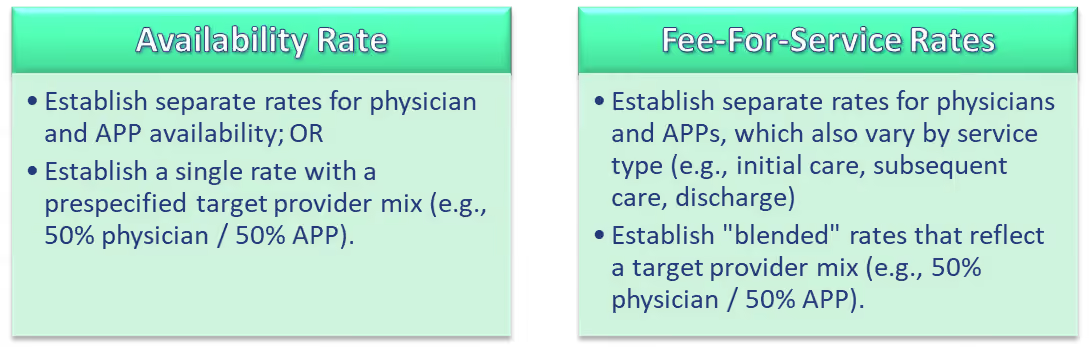
Given the differences in cost and scope of practice between physicians and APPs, hospitals must evaluate the appropriate types of providers delivering telemedicine services. Most telemedicine providers employ or contract with both physicians and APPs. Therefore, when entering into TSAs with hospitals, we have seen telemedicine practices offer both types of providers as options for care, often deferring to the hospital regarding protocols for when a given provider type should be used. It is essential that compensation for telemedicine services in the TSA match the agreed upon utilization of the provider types. Silence or muddled verbiage on this topic within a TSA can lead to the following trip-ups related to VBC objectives:
To avoid this misstep, we recommend that TSAs clearly specify the provider types that will be used for the services, and that compensation terms in the TSA ensure congruence between the payment amount and type of provider. We commonly see payment for telemedicine services provided to hospitals structured in one of two ways: (1) a fixed availability fee (typically paid daily or monthly) to cover availability for services over a predetermined period of time; or (2) fee-for-service rates based on the type of service provided. The diagram below shows how TSAs can be structured, depending on payment type, to preclude trip-ups:
In order to deliver telemedicine services, providers must establish an infrastructure that allows for effective care. For example, prior to the COVID-19 pandemic, CMS often required telemedicine providers to interact with patients using face-to-face video technology, in order to be eligible to bill for the service. This interactive video technology requires software licenses and sufficient internet bandwidth in order to operate. Furthermore, as VBC requires accurate documentation of care in the electronic health records (EHRs), telemedicine providers typically must integrate their platform with a hospital’s electronic health records system. Finally, though costs associated with a brick-and-mortar practice are not incurred by telemedicine providers, they do incur operating costs not borne by traditional medical practices, including: marketing and customer acquisition costs, licensing of providers across states, and unique business office expenses (e.g., telemedicine platform development).
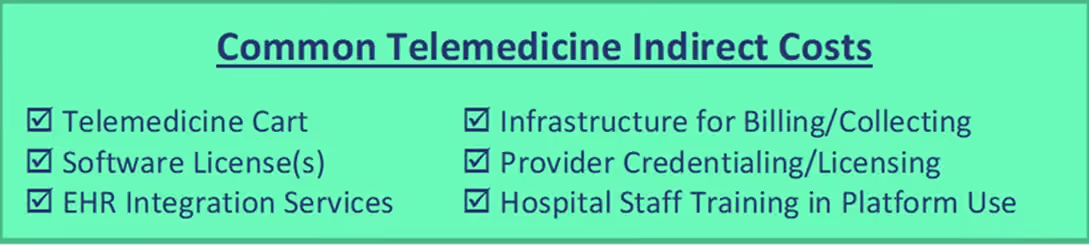
While some of these business expenses must be borne by the telemedicine provider (e.g., marketing and business office costs), it is possible for hospitals to directly provide or otherwise contract for some of the resources needed to deliver telemedicine. A common example of costs that either party may bear is the telemedicine cart located at the hospital to facilitate face-to-face interactive video. We have observed that hospitals either own their own carts or contract with the telemedicine provider to utilize one of their carts. In addition, some facilities choose to leverage their resources to license and credential telemedicine providers, while others have the telemedicine company perform that work.
In order to establish compensation rates that match the level of services, the TSA should detail which party will bear the various expenses that enable telemedicine services. Many of these items are necessary for the success of VBC initiatives. For instance, a telemedicine platform that is well-integrated into the EHR of a hospital, can ensure the necessary reporting and quality monitoring required by VBC. Refer to the figure below for a list of common expenses that should be accounted for in the TSA and associated payment terms:


Lorem ipsum dolor sit amet, consectetur adipiscing elit. Suspendisse varius enim in eros elementum tristique. Duis cursus, mi quis viverra ornare, eros dolor interdum nulla, ut commodo diam libero vitae erat. Aenean faucibus nibh et justo cursus id rutrum lorem imperdiet. Nunc ut sem vitae risus tristique posuere.
Share this entry: