On November 20, 2020, the Centers for Medicare and Medicaid Services (CMS) and the Office of the Inspector General (OIG) for the Department of Health and Human Services (HHS) published final rules intended to update and modernize the Physician Self-Referral (aka Stark) regulations and the Anti-Kickback Statute (AKS) safe harbors, respectively, in conjunction with the “Regulatory Sprint to Coordinated Care” advanced by HHS. Both agencies stated that a primary purpose of the revisions was “to remove potential barriers to more effective coordination and management of patient care and delivery of value-based care.”[1] As such, both agencies introduced exceptions (Stark) and safe harbors (AKS) that were intended to promote the development of innovative value-based care arrangements through the use of so-called Value-Based Enterprises (VBEs) that were intended “to accelerate the transformation of the health care system into one that better pays for value and promotes care coordination.”[2] Much more detail on the content of the Stark exceptions and AKS safe harbors can be found here.

These changes to Stark and AKS were heralded by many industry participants as potentially transformative. Nevertheless, nearly 18 months after their regulatory introduction, these paths to value-based care arrangements have not yet been utilized in widespread fashion. In this edition of Insights InHealth, we explore some reasons why the adoption of VBEs has, at least thus far, been limited. Finally, we discuss some current market factors that may lead to increased deployment of such value-based structures in the near future.
These changes to Stark and AKS were heralded by many industry participants as potentially transformative. Nevertheless, nearly 18 months after their regulatory introduction, these paths to value-based care arrangements have not yet been utilized in widespread fashion. In this edition of Insights InHealth, we explore some reasons why the adoption of VBEs has, at least thus far, been limited. Finally, we discuss some current market factors that may lead to increased deployment of such value-based structures in the near future.
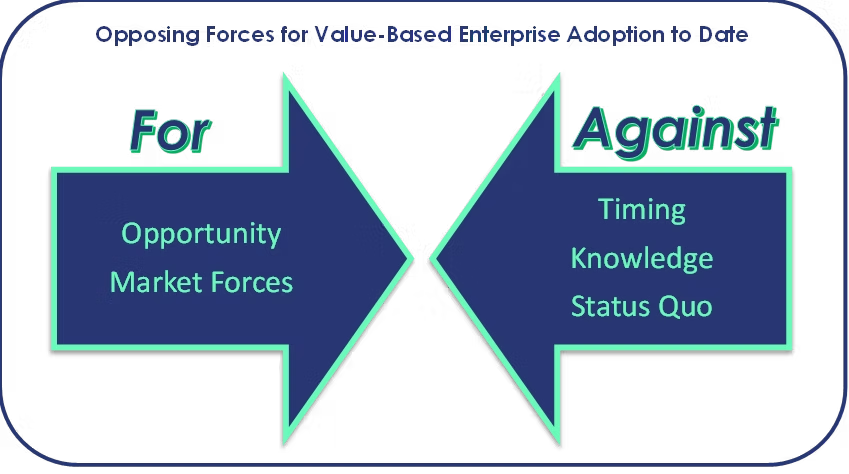
With the release of the two final rules in late 2020, the new regulations took effect in January 2021. At that time, many hospitals were grappling with another surge of COVID-19 cases. While the management of the pandemic seemingly became less daunting as 2021 progressed with the proliferation of vaccines, hospitals generally continued to devote substantial manpower and efforts to this fight. As such, many hospital leaders were necessarily focused on the immediate clinical and staffing imperatives before them, not long-term strategic opportunities such as adoption of VBEs.
Stark and AKS are complicated, multi-layered regulations. Furthermore, there are some very substantial differences between the Stark exception and the AKS safe harbors. Accordingly, it has taken the industry some time to digest these new opportunities and devise arrangements compliant with both Stark and AKS that will permit large-scale integration of VBEs into the healthcare delivery landscape.
While HHS implemented these changes in support of its Regulatory Sprint to Coordinated Care, the external patient and payor pressure needed to drive rapid implementation of VBEs in the face of a pandemic have been insufficient. According to a survey published in 2020, only 26 percent of physician practice respondents and 8 percent of hospital/health system respondents participated in payment models with shared losses or downside financial risk. Absent demand-side preferences from consumers or pressure from payors to alter provider incentives, the force needed to propel organizations away from fee-for-service payment models has not materialized.
Prior to 2020, most physician employers that utilize wRVU-based compensation plans had not encountered any significant downside to using this model to compensate physician employees. In general, the model had been easy to understand, easy to administer, and was somewhat self-maintained by the Medicare Physician Fee Schedule (MPFS). As such, most provider organizations were not seriously considering implementing significantly different compensation models when the final rules were published. This was especially the case during the pandemic, which stretched organizational resources and energy in the direction of addressing immediate needs related to combatting COVID-19.
In the 17 months since the release of the Stark and AKS final rules, many of the factors inhibiting VBE implementation to date have evolved. A summary of these changes is included in the following table.
Based on this evolution of market forces, we anticipate a significant wave of adoption in VBEs in the next three to five years as provider organizations begin to meaningfully transition from volume to value-based payment systems. Future editions of Insights InHealth will examine new VBE model structures and how they will help provider organizations transform their care delivery.


Lorem ipsum dolor sit amet, consectetur adipiscing elit. Suspendisse varius enim in eros elementum tristique. Duis cursus, mi quis viverra ornare, eros dolor interdum nulla, ut commodo diam libero vitae erat. Aenean faucibus nibh et justo cursus id rutrum lorem imperdiet. Nunc ut sem vitae risus tristique posuere.
Share this entry: